
Imagine this. You sit down to eat at a wedding reception in Salem, and just as you bite into a crispy murukku, you feel your denture shift. You press your lips together, smile politely, and quietly stop eating. You spend the rest of the evening worrying instead of enjoying.
If that story sounds familiar, you are not alone. Millions of people across India live with missing teeth or traditional dentures that clip their confidence every single day. The good news? Dentistry has come a long way. Today, two full-arch solutions stand out above the rest: snap-in dentures and fixed All-on-4 implants.
Both can give you back a full set of teeth. But they work very differently, cost differently, and suit different people differently.
Let’s break it down so you can walk into your dentist’s office knowing exactly what to ask.
What Are Snap-In Dentures?
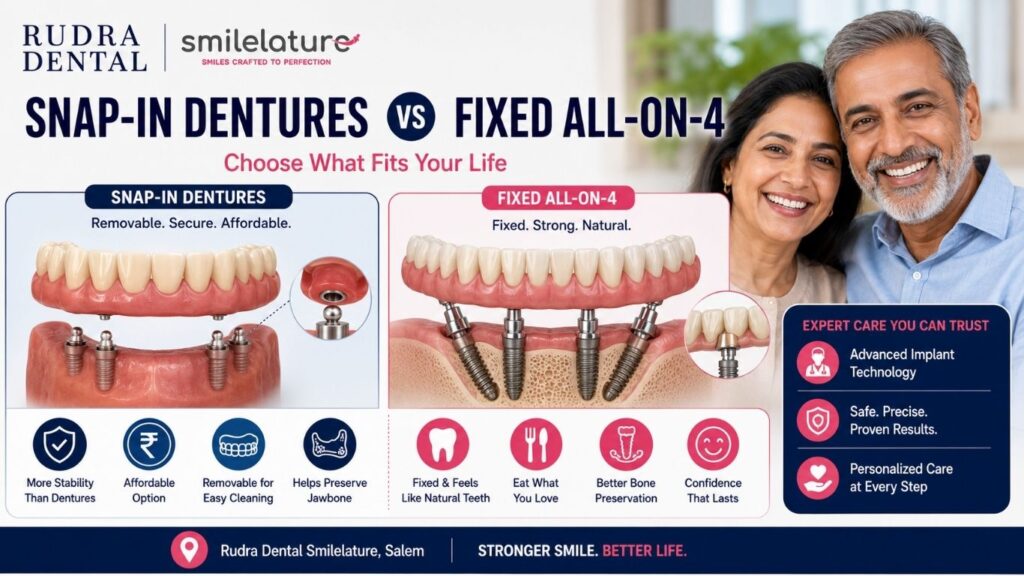
Snap-in dentures, also called implant-retained overdentures or implant-supported dentures, are a step up from traditional removable dentures. Instead of relying on adhesive or suction to stay in place, they attach to two or four dental implants placed in your jawbone.
Here is how the mechanism works. Small titanium posts go into your jaw surgically. After healing, special ball-socket or bar attachments on the implants connect with the denture. You press the denture in place, it clicks, and it stays put until you remove it at night.
The American Dental Association notes that implant-retained overdentures offer better stability and chewing ability compared to conventional full dentures, and they also help preserve jawbone over time (American Dental Association, Implant-Retained Overdentures, ada.org).
Who typically goes for snap-in dentures?
- People who want more stability than traditional dentures but find full implant surgery daunting
- Patients with reduced bone density who may not qualify for a full fixed arch without bone grafting
- Those looking for a lower-cost implant-supported option
- Anyone who prefers to remove their prosthesis for easier cleaning
What Is a Fixed All-on-4 Implant Bridge?
The All-on-4 concept was developed by Portuguese implantologist Dr. Paulo Malo in the late 1990s and has since become one of the most studied full-arch restoration methods in the world (Malo P et al., All-on-4 Treatment Concept, Clinical Implant Dentistry and Related Research, 2003).
Here is the idea. Four titanium implants go into your jawbone at specific angles. Two at the front sit vertical. Two at the back tilt up to 45 degrees to avoid the sinuses and reach denser bone. A full-arch prosthetic bridge then attaches permanently to these four implants.
You cannot remove it at home. It functions, looks, and feels like natural teeth. You brush it like your own teeth. You eat with it like your own teeth. No removal, no adhesives, no worrying at a wedding reception.
At Rudra Dental – Smilelature in Salem, the All-on-4 method is offered as part of a broader dental implant programme that also covers All-on-6 and All-on-8 configurations for patients who need more support across the arch.
Snap-In Dentures vs. Fixed All-on-4: The Side-by-Side Picture
Let’s go through each factor you actually care about.
Stability and Eating Comfort
Snap-in dentures are more stable than conventional dentures, but they are not as stable as a fixed bridge. The attachment can loosen over years. You may still avoid very hard or sticky foods.
Fixed All-on-4 gives you near-natural biting force. Research published in the International Journal of Oral and Maxillofacial Implants found that patients with fixed implant-supported bridges reported significantly higher chewing function scores compared to those with removable overdentures (Attard NJ, Zarb GA, Long-term treatment outcomes in edentulous patients with implant overdentures, 2004).
Winner for eating comfort: Fixed All-on-4.
Bone Preservation
Every time you lose a tooth, the jawbone below it starts to shrink. This process is called bone resorption. Traditional dentures speed it up because they press on the gums but do not stimulate the bone.
Snap-in dentures with two implants slow bone loss in the implant zones but do not protect the entire jaw.
Fixed All-on-4, because it places four implants across the arch at strategic angles, stimulates a wider area of bone. This helps preserve the natural shape of your jaw and face over time.
Winner for bone preservation: Fixed All-on-4.
Daily Maintenance
Snap-in dentures: Remove at night, clean separately, clean the implant attachments, let the gums rest. Some patients find this routine freeing. Others find it inconvenient.
Fixed All-on-4: Brush twice a day. Use interdental brushes or a water flosser to clean underneath the bridge. Visit your dentist for routine professional cleaning. No removal involved.
Neither option is difficult, but they suit different personality types. If you want a routine similar to brushing natural teeth, go fixed. If you prefer a removable prosthesis, snap-in works.
Surgery and Recovery
Snap-in dentures need only two to four implants. Less surgery, shorter recovery time, and often no need for bone grafting in patients with moderate bone loss.
Fixed All-on-4 is still a relatively minimal surgical procedure compared to placing eight individual implants, but it is more involved than snap-in. Most patients receive a temporary bridge on the day of surgery and a permanent one after three to six months of healing.
Less surgery: Snap-in dentures.
Cost
In India, snap-in dentures tend to cost less upfront than fixed All-on-4 because fewer implants are placed and the prosthetic itself is removable rather than custom-milled. That said, when comparing the full mouth dental implant cost in India, the cost of replacing worn attachments and periodic denture relining adds up over years.
Fixed All-on-4 carries a higher initial cost, but many patients find it more cost-effective over a decade because the fixed bridge does not need frequent replacement or adjustment.
Always ask your dental clinic for a long-term cost estimate, not just the day-one number.
Aesthetics
Both options can look very natural with quality prosthetic work. Fixed All-on-4 tends to look more like natural teeth because the gum line is designed to sit against your own gums without a visible flange of acrylic.
Snap-in dentures often include a pink acrylic gum section that can look slightly more prosthetic, particularly when smiling broadly.
For aesthetics: Fixed All-on-4 has a slight edge.
How to Know Which One Is Right for You
This is where the conversation gets personal. There is no single right answer for everyone. Here is a simple framework.
Consider snap-in dentures if:
- You have significant bone loss and want to avoid or delay bone grafting
- Budget is a firm constraint right now
- You are comfortable with a removable prosthesis
- You want a shorter surgical procedure
- You are older and prefer less invasive surgery
Consider Fixed All-on-4 if:
- You want the closest thing to natural teeth
- You eat a varied diet and want full chewing ability
- You want to stop thinking about your denture throughout the day
- Long-term bone preservation matters to you
- You are willing to invest upfront for a more permanent result
A good implantologist will assess your bone density using a CT scan or OPG X-ray, review your medical history, and talk through your lifestyle before recommending anything.
What the Process Looks Like at a Dental Clinic
Whether you choose snap-in dentures or Fixed All-on-4, the journey follows a similar structure.
Step 1: Initial consultation and imaging. Your dentist studies your bone density, jaw structure, and gum health.
Step 2: Treatment planning. The number of implants, placement angles, and prosthetic design are mapped out.
Step 3: Implant surgery. Titanium posts are placed under local anaesthesia. Most patients report mild discomfort for a few days after.
Step 4: Healing phase. Osseointegration, the process where the implant fuses with your bone, takes three to six months. With Fixed All-on-4, you often get a temporary prosthesis during this period.
Step 5: Final prosthesis fitting. The permanent denture or bridge is attached and adjusted for bite, fit, and appearance.
At Rudra Dental – Smilelature, Salem, the team under Dr. Rhoopesh Venkatraman (BDS, FDS, ADS, MFM in Restorative Dentistry and Implantology) carries out the full assessment and surgical process in-house. The clinic runs two branches in Salem: one at Fairlands and one at Suramanagalam, making it accessible from most parts of the city.
A Quick Note on All-on-6 and All-on-8
Some patients ask about going beyond four implants. All-on-6 uses six implants and is a good option when slightly more bone support is needed. All-on-8 uses eight and is suited to patients with denser bone who want maximum stability.
The basic principle remains the same. More implants generally mean better load distribution and more stability. Your implantologist will tell you which configuration your bone volume supports.
Frequently Asked Questions
1. Can snap-in dentures fall out while eating or speaking?
If properly fitted on implants, snap-in dentures are very stable during normal activities like eating and speaking. They click firmly onto the implant attachments. They do not fall out the way conventional dentures can. That said, the retention can weaken over years as the rubber O-rings or clips wear out, requiring periodic replacement.
2. Is the Fixed All-on-4 surgery painful?
The surgery itself is done under local anaesthesia, so you feel little to no pain during the procedure. Post-surgery soreness is normal for three to five days and is managed with prescribed pain relief. Most patients return to a soft-food diet within a few days and feel comfortable within two weeks.
3. How long do Fixed All-on-4 implants last?
With good oral hygiene and regular dental check-ups, the implants themselves can last 20 years or more. The prosthetic bridge may need replacement or repair after 10 to 15 years depending on wear. Research shows high long-term survival rates for well-placed implants when patients maintain proper care (Malo P et al., Implant-Supported Immediately Loaded Fixed Prostheses, 2012).
4. Can I upgrade from snap-in dentures to Fixed All-on-4 later?
Yes. If you start with snap-in dentures and later want a fixed solution, your existing implants may be used as part of the new fixed restoration, depending on their number and position. Your dentist will evaluate whether new implants are needed. Many patients start with snap-in dentures and switch to fixed once they are ready for the next step.
5. What is the right age to get All-on-4 implants?
There is no upper age limit. Patients in their 70s and 80s can receive implants safely if they are in reasonable general health and have adequate bone. The more relevant factors are bone density, gum health, and any systemic conditions like uncontrolled diabetes that can affect healing. Your dentist will review your full medical history before recommending a plan.