
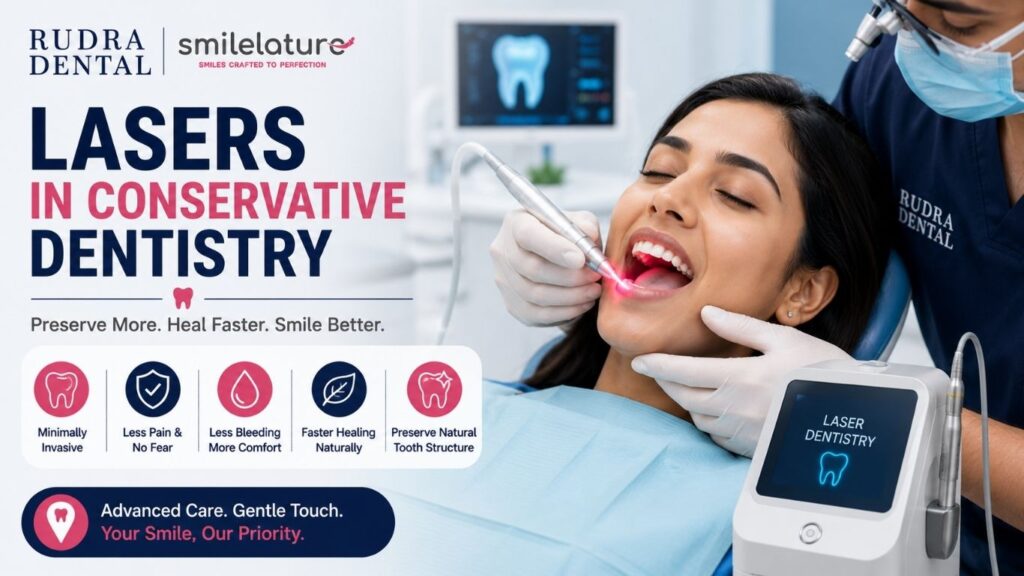
Conservative dentistry means preserving as much of your natural tooth structure as possible, versus drilling it away. Lasers have become much more prominent in conservative dentistry than many patients are aware. Ever flinch at the sound of your dentist’s drill? Read this article on lasers in conservative dentistry and that sound might soon become a thing of the past.
What Does Conservative Dentistry Mean?
Conservative Dentistry involves dental procedures which save the maximum amount of your natural tooth structure. Dental fillings, root canal treatment or treatment of cavities are some of the examples of conservative dentistry. The principle of conservative dentistry is simple extract only what needs to be extracted and do not disturb the healthy tooth structure which is not causing any problem.
All dental professionals in India including our doctors at Rudra Dental Smilelature in Salem practice conservative dentistry as natural teeth function better and last longer compared to any other tooth replacement.
How Do Dental Lasers Work?
LASER is an acronym for Light Amplification by Stimulated Emission of Radiation. A dental laser emits a thin, focused beam of light. As that beam of light contacts tooth or gum tissue it interacts with that tissue and vaporizes it, cuts it, or seals it based on the wavelength and settings determined by the dentist.
Lasers have been used in dentistry since the mid-90s. The first laser system cleared by the FDA for hard tissue cavity treatment was introduced in 1997 allowing general dentists the opportunity to begin using lasers (ADA News, May 1997). Dental lasers have undergone several clearance reviews since that time and are now manufactured for use on cavities, periodontal applications and diagnostics.
Role of Lasers in Conservative Dentistry
Lasers in conservative dentistry show up in several everyday procedures. Here is a look at where they fit in.
1. Cavity Treatment With Less Tooth Removal
A traditional drill removes healthy and decayed tooth material together because it cannot always tell the difference between the two. A laser targets decayed tissue with more precision, so the dentist clears out the cavity while keeping more of the healthy enamel around it. This matches the basic aim of conservative dentistry: keep the natural tooth intact wherever possible.
2. Gum Contouring Without Cuts
Uneven gums, a gummy smile, or minor gum reshaping used to mean a scalpel and stitches. A soft tissue laser reshapes the gum line with little to no bleeding, since the beam seals small blood vessels as it works. Patients usually skip the stitches altogether.
3. Treating Tooth Sensitivity
Certain lasers seal the tiny tubules on exposed root surfaces that cause sharp pain from hot, cold, or sweet food. This is a common walk-in complaint at most clinics, and laser treatment often settles it in one sitting.
4. Lowering Bacteria During Fillings and Root Canals
The heat from a laser has a mild sterilizing effect on the treatment site. This lowers the bacterial count before a filling or root canal seal goes in, which supports better long-term results for the tooth.
5. Frenectomy and Soft Tissue Correction in Children
A tight tongue-tie, known as a restricted frenulum, can affect feeding in babies and speech later on. A laser frenectomy is quick, usually needs no stitches, and heals fast, which matters when the patient is a young child.
Benefits of Laser-Based Conservative Treatments
Patients often ask what makes laser dentistry worth choosing over a drill. Here is a short answer:
- Less discomfort, often without local anaesthesia
- Reduced bleeding, since the laser seals vessels as it works
- Lower infection risk from the sterilizing heat of the beam
- Faster healing and less swelling after the procedure
- Better preservation of healthy tooth structure
- Fewer stitches needed for soft tissue work
Peer-reviewed research on dental lasers points out that ADA guidelines recognize their use in surgical and non-surgical procedures, largely because they cut down on bleeding, discomfort, and post-treatment infection (Laser Technology in Dentistry, PMC, National Library of Medicine, 2024). These advancements also support modern cosmetic treatments like Laser Teeth Whitening in Salem, offering patients a more comfortable and efficient dental experience.Peer-reviewed research on dental lasers points out that ADA guidelines recognize their use in surgical and non-surgical procedures, largely because they cut down on bleeding, discomfort, and post-treatment infection (Laser Technology in Dentistry, PMC, National Library of Medicine, 2024).
Laser Dentistry vs Traditional Drilling: Quick Comparison
| Factor | Traditional Drill | Laser Treatment |
| Pain | Often needs anaesthesia | Usually minimal, anaesthesia-free |
| Bleeding | More common | Reduced, vessels seal as the laser works |
| Sterilization | Standard cleaning only | Heat sterilizes the site |
| Healing time | Slower | Faster in most cases |
| Sound and vibration | Present | Absent |
This table sums up why many patients, especially children and nervous adults, prefer laser-based conservative dentistry over the drill.
Are Lasers Suitable for Every Patient?
Lasers aren’t needed in all situations. Procedures that involve deep decay close to the pulp chamber, many crown preparations, and certain orthodontic treatments may still require traditional instruments. Your dentist will examine your tooth and X-rays, then determine if the laser or drill or combination of both will work best. That decision is made on the specifics of your situation, not based on which instrument sounds high-tech.
The doctors at Rudra Dental Smilelature review your dental history and present condition before making a laser treatment recommendation so we can create a treatment plan based on your actual needs rather than one protocol for all patients.
Cost and Session Considerations
Laser treatment can run slightly higher per appointment when compared to a traditional filling or minor gum procedure. When you consider that laser procedures usually require less follow-up appointments and chair time overall, patients often discover the price is comparable to traditional methods if not cheaper when you consider fewer appointments and less medication after procedure.
Final Thoughts
Lasers provide dentists with an avenue for performing dental procedures while preserving as much healthy tissue as possible. Whether it’s filling cavities, reshaping gums or alleviating sensitivity, laser dentistry in Salem allows dentists to provide services that follow the main principle of conservative dentistry: Repair what needs to be repaired and leave the rest alone. The best way to determine if your smile is a candidate for laser treatment is to schedule an appropriate office visit that includes x-rays. Learn more about your laser dentistry options at rudradental-smilelature.com or schedule a consultation with Salem’s team.
Frequently Asked Questions
1. Is laser dental treatment painful?
Most patients feel little to no pain during laser dental work. Many procedures need no local anaesthesia at all, since the laser causes far less trauma to the tissue compared to a drill or scalpel.
2. How long does laser gum treatment take to heal?
Healing after laser gum procedures usually takes a few days to a week, faster than the two to three weeks common after conventional gum surgery, since the laser seals tissue as it works.
3. Can lasers replace a dental drill completely?
No. Lasers work well for many cavity and gum procedures, but some deep restorations, crown preparations, and specific cases still call for a drill or other conventional tools alongside laser care.
4. Is laser treatment safe for children?
Yes. Pediatric procedures like frenectomy respond well to laser treatment, mainly because it needs no stitches, causes little bleeding, and keeps the visit short and less stressful for a child.
5. Does laser dentistry cost more than regular treatment?
It can cost a bit more per visit, but laser treatment often needs fewer follow-up sessions and less medication afterward, which balances out the total cost over the course of treatment.
Sources:
- FDA Approves First Dental Laser System for Treating Decay, ADA News, May 1997 – http://www.qualitydentistry.com/htopics/laser/laser.html
- Laser Technology in Dentistry: From Clinical Applications to Future Innovations, PMC, National Library of Medicine, 2024 – https://pmc.ncbi.nlm.nih.gov/articles/PMC11674728/
- Laser Use in Dentistry, WebMD, 2024 – https://www.webmd.com/oral-health/laser-use-dentistry
- Laser Dentistry in Salem, Rudra Dental Smilelature – https://rudradental-smilelature.com/laser-dentistry-in-salem/